
Introduction
Starting a business website is one of the most important steps a company can take today.
Many businesses understand this. They invest time and money to build a website, expecting it to attract customers and drive growth.
But after launching, they begin to notice a problem.
The website exists — but it does not bring results.
- There are no inquiries.
- No consistent leads.
- No real business impact.
At that point, most assume the issue is design, marketing, or lack of traffic.
But in many cases, the real problem is much simpler.
The website is not structured properly.
A business website is not just a collection of pages. It is a system designed to guide visitors from interest to action.
If the right pages are missing — or if they are not designed correctly — the website will not convert visitors into customers.
Why Website Structure Matters More Than Design
Many business owners focus heavily on how their website looks.
They carefully choose colors, animations, and layouts. While design is important, it is not the main factor that determines results.
What truly matters is how your website is structured.
Structure defines:
- What information users see first
- How they move through your website
- Whether they understand your value
- Whether they take action
A well-structured website feels clear and easy to use.
A poorly structured website feels confusing and incomplete.
Even if your design looks modern, a weak structure will cause visitors to leave without taking any action.
The Most Important Pages Every Business Website Must Have
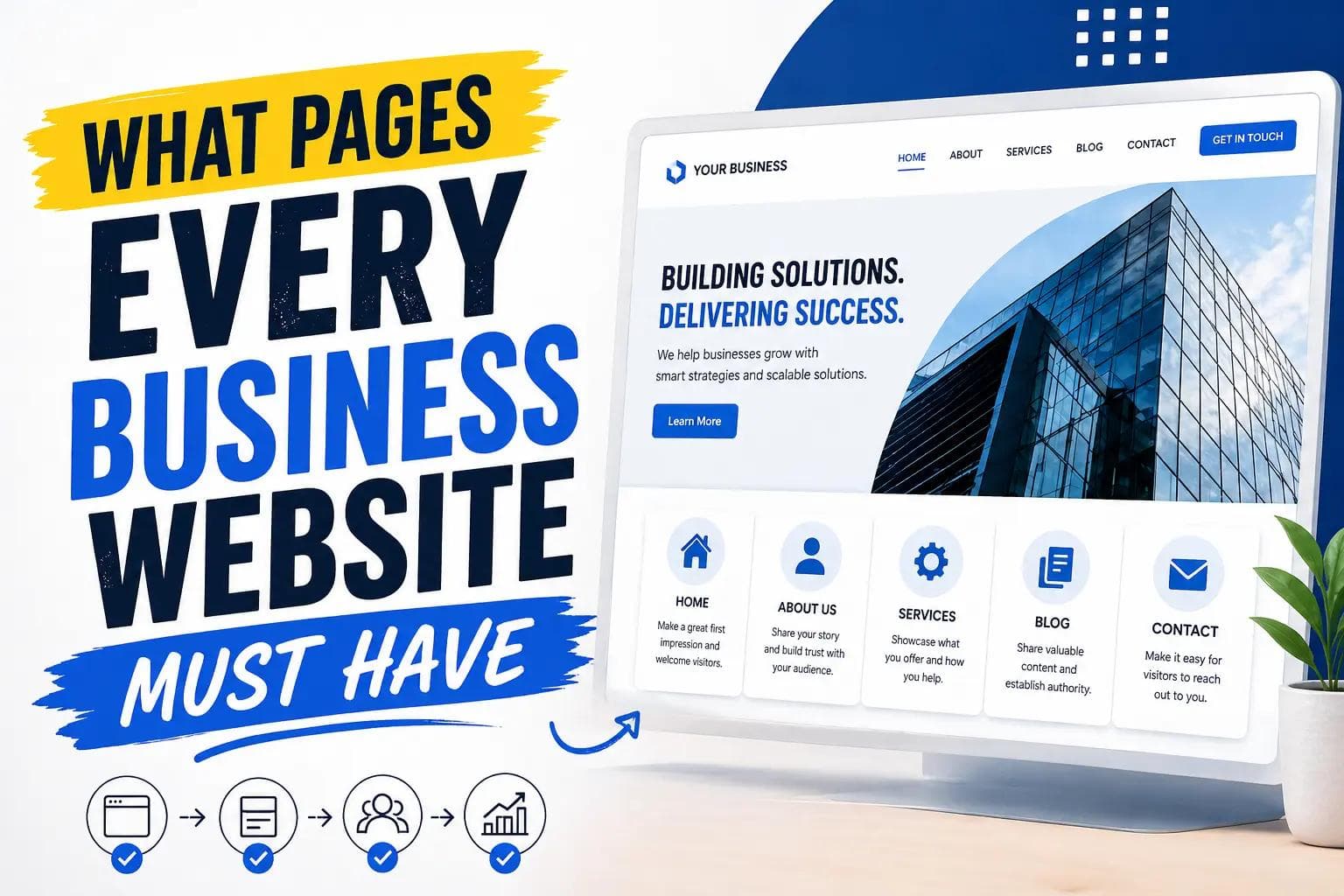
To function properly, every business website needs a set of core pages that work together to guide the user.
Let’s go through each of them in detail.
1. Homepage – Your First Impression
The homepage is the most important page on your website.
It is usually the first place visitors land, and it decides whether they stay or leave.
Within a few seconds, your homepage should clearly explain:
- What you do
- Who you help
- What result you provide
Many websites fail because their homepage is too vague.
They use general statements that do not clearly communicate value.
A strong homepage should guide the visitor step by step and include:
- A clear headline
- Short explanation of services
- Trust elements (reviews, projects)
- A clear call-to-action
Your homepage should not try to say everything. It should guide users toward the next step.
2. Services Page – Explain What You Actually Offer
Your services page is where you clearly explain what you provide.
Many businesses make the mistake of simply listing services without explanation.
Visitors need to understand:
- What exactly you offer
- How it works
- How it helps them
A good services page breaks things down simply and focuses on benefits, not just features.
For example, instead of just saying “Web Development,” you should explain what kind of websites you build and how they help businesses grow.
3. About Page – Build Trust and Credibility
Many people think the About page is not important.
In reality, it plays a major role in building trust.
When visitors consider working with you, they want to know:
- Who you are
- What your experience is
- Why they should trust you
A strong About page should feel human and real.
It should not just talk about the company — it should explain your story, your approach, and your values.
Trust is one of the biggest factors in conversion, and this page helps build it.
4. Contact Page – Make It Easy to Reach You
This may sound simple, but many websites make it difficult for users to get in touch.
A good contact page should remove all friction.
It should include:
- Contact form
- Phone number
- Optional: WhatsApp or quick contact option
The goal is to make it as easy as possible for someone to reach out.
If users have to search for contact details or go through multiple steps, many will simply leave.
5. Portfolio or Projects Page – Show Real Work
People trust what they can see.
If you provide services, showing your past work is one of the most powerful ways to build credibility.
A portfolio page allows visitors to:
- See what you have done
- Understand your quality
- Visualize results
This reduces doubt and increases confidence.
Even simple examples can make a big difference.
6. Blog or Insights Page – Build Authority
A blog is not just for writing content.
It is a powerful way to:
- Educate your audience
- Answer common questions
- Show your expertise
When people read useful content on your website, they start seeing you as someone who understands their problems.
This builds authority and increases the chances of them choosing you.
7. Clear Call-to-Action (Across All Pages)
One of the biggest mistakes is not guiding the user.
Every important page should include a clear next step.
This could be:
- Contact us
- Get a quote
- Schedule a consultation
If you do not guide users, they will not take action.
A website should always lead the visitor somewhere.
Why Most Websites Get This Wrong
Many websites fail not because they lack pages, but because those pages are poorly executed.
Common problems include:
- Pages with unclear content
- Too much information without structure
- No clear direction for the user
- Missing trust elements
In some cases, websites include all the pages but still fail because they are not connected properly.
The result is a website that looks complete but does not perform.
How to Fix Your Website Structure
Improving your website does not always require a complete redesign.
Start by reviewing your pages and asking:
- Does each page have a clear purpose?
- Does it guide the user to the next step?
- Is the information easy to understand?
Focus on clarity, simplicity, and flow.
A well-structured website should feel natural to navigate.
Final Thoughts
A successful website is not just about design or technology.
It is about structure.
When your website has the right pages, arranged in the right way, it becomes much more than an online presence.
It becomes a system that:
- Attracts visitors
- Builds trust
- Converts users into customers
Without this structure, even a beautiful website will struggle to deliver results.
📞 Need Help?

If your website is not generating results or if you are planning to build one the right way,
Codilent IT Solutions can help you create a well-structured, high-performing website that actually brings customers.
We help you with:
- Website design and development
- Structure and strategy
- Performance optimization
Contact us today for a FREE consultation and build a website that works for your business.
Have an idea worth building?
Let’s turn your next digital product idea into a meaningful, high-performing experience.